hash8 min
Hash Functions: SHA-2, SHA-3, and HMAC
Understand checksums, cryptographic hashes, HMAC, collision resistance, and why SHA-1 or MD5 should not protect security-sensitive data.
Read more→Generate SHA-2 (SHA-256, SHA-384, SHA-512) & SHA-3 (SHA3-256, SHA3-384, SHA3-512) hashes + HMAC for free. Compare file & text checksums. 100% client-side.
Processing: local in your browser
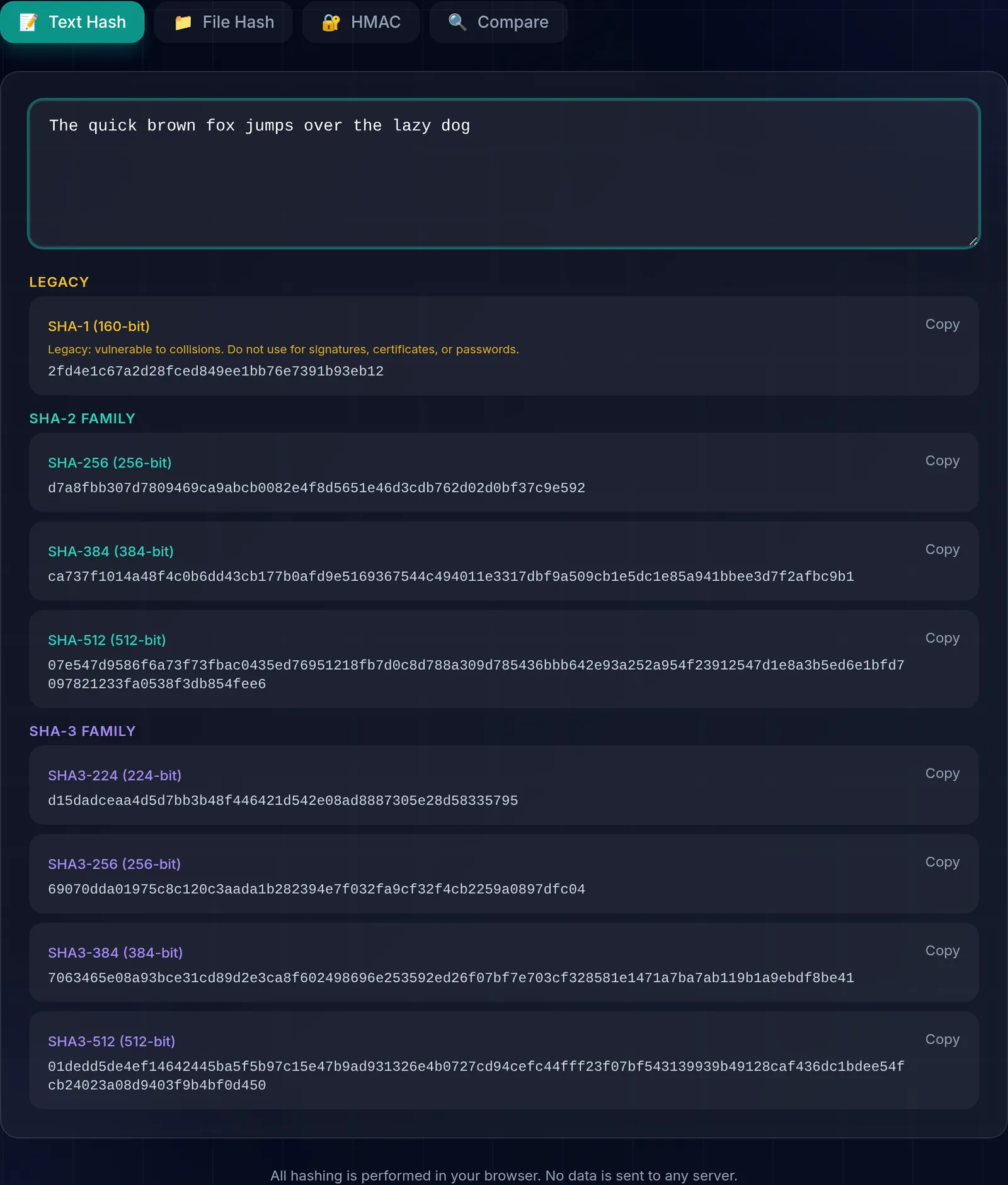
Our hash generator lets you create cryptographic fingerprints of text and files using the most secure algorithms available. It supports the full SHA-2 family (SHA-256, SHA-384, SHA-512) and SHA-3 (SHA3-256, SHA3-384, SHA3-512), as well as HMAC for secret-key message authentication.
SHA-2 is the current widely adopted standard, used in TLS/SSL, digital signatures, blockchain, and X.509 certificates. SHA-3 (Keccak) is the newest NIST standard, released in 2015, with a sponge construction architecture entirely different from SHA-2 Merkle-Damgard construction. This provides complementary resistance: if a weakness were discovered in SHA-2, SHA-3 would not be affected. Both families are secure for current use.
HMAC (Hash-based Message Authentication Code) combines a hash function with a secret key to verify both the integrity and authenticity of a message. It is widely used in APIs, JWT tokens, webhooks, and secure communication protocols.
Hashes let you verify that a file has not been modified by comparing its checksum with the value published by the author. This is essential for software downloads, file transfers, security auditing, and backup verification. All computation happens in your browser using the Web Crypto API, without sending your data to any server.
In practice, the algorithm you pick depends on the goal. To verify the integrity of a download (an ISO image, an installer, or a backup), SHA-256 is enough and is the value developers usually publish next to the file: generate the hash of the downloaded file and confirm it matches character for character. To authenticate requests between services (webhooks, internal APIs), HMAC with a shared secret key is the standard approach, so only a party that knows the key can produce a valid signature; SHA-256 or SHA-512 as the underlying function are the common choices. When you work with systems that require SHA-3 by policy or by design, SHA3-256 offers the same security level as SHA-256 with a different internal construction.
Three confusions come up repeatedly. The first is treating a hash like encryption: a hash is a one-way function and cannot be reversed to recover the original text, so it is not a way to protect data you need to read back. The second is using MD5 or SHA-1 for security purposes; both are broken against collisions and should only appear when checking legacy checksums, never for signatures or critical integrity. The third is storing passwords with a fast hash such as SHA-256: passwords need slow, salted functions built for that purpose, like bcrypt, scrypt, or Argon2. This tool computes integrity and authentication fingerprints; it is not a replacement for a password-storage system.
Learn more with related in-depth guides and tutorials.
Understand checksums, cryptographic hashes, HMAC, collision resistance, and why SHA-1 or MD5 should not protect security-sensitive data.
Read more→Use provenance, real file type, hashes, macros, and malware scanning as layers of evidence—without mistaking a clean result for proof of safety.
Read more→Inspect location, author, software, and document-history metadata before sharing a file, and understand what removal tools may leave behind.
Read more→All hashing is performed in your browser. No data is sent to any server.